
What is IVF Treatment? IVF (In Vitro Fertilization) is a fertility treatment where an egg and sperm are combined outside the body in a laboratory to form an embryo, which is then transferred into the uterus. It helps couples facing infertility due to blocked tubes, low sperm count, ovulation issues, or unexplained infertility achieve a successful pregnancy.
Introduction
Struggling to conceive can be one of the most emotionally difficult experiences a couple goes through. If you’ve been trying for a baby without success, you are not alone — and modern medicine has made remarkable progress in helping couples become parents. KD-What is IVF Treatment?
IVF Treatment in Ludhiana has become a trusted path to parenthood for thousands of couples across Punjab. Whether the cause is male infertility, female infertility, or unexplained reasons, IVF offers hope backed by decades of medical research and continually improving success rates.
At Lama Hospital & Fertility Clinic, recognized as one of the Best IVF Clinics in Ludhiana, we understand that every couple’s fertility journey is unique. This comprehensive guide explains what IVF treatment is, who needs it, how it works, what it costs, and how to prepare — so you can make an informed decision with confidence.
Key Takeaways -KD What is IVF Treatment?
IVF is a proven Assisted Reproductive Technology (ART) used worldwide for over four decades. It is recommended for blocked fallopian tubes, male infertility, ovulation disorders, endometriosis, and unexplained infertility. Success rates depend on age, egg/sperm quality, and clinic expertise. The IVF process typically takes 4–6 weeks from stimulation to embryo transfer. Choosing an experienced Fertility Specialist in Ludhiana significantly improves outcomes. Lifestyle, diet, and stress management play a supporting role in treatment success.
What is IVF Treatment? – What is IVF Treatment?
IVF, or In Vitro Fertilization, is one of the most widely used Assisted Reproductive Technology (ART) procedures globally. The term “in vitro” literally means “in glass,” referring to the laboratory dish where fertilization takes place outside the human body.
What is IVF Treatment? In simple terms, IVF treatment involves:
- Stimulating the ovaries to produce multiple eggs
- Retrieving those eggs through a minor procedure
- Fertilizing the eggs with sperm in a laboratory
- Culturing the resulting embryos for a few days
- Transferring a healthy embryo into the uterus
If you’re searching for What is IVF Treatment, understand that it is not a single-step procedure but a carefully monitored medical journey involving hormonal treatment, precision timing, and skilled embryology.
According to reproductive health organizations such as the World Health Organization (WHO) and the American Society for Reproductive Medicine (ASRM), infertility affects millions of couples worldwide, and IVF remains one of the most effective solutions when natural conception or simpler treatments do not succeed.
Learn More : IVF Treatment in Ludhiana – Best In Vitro Fertilization Centre in Punjab
Who Needs IVF?
IVF is recommended for individuals and couples facing a range of fertility challenges. You may be advised to consider IVF if you experience:
- Blocked or damaged fallopian tubes
- Severe male infertility (low sperm count, poor motility)
- Ovulation disorders such as PCOS
- Endometriosis affecting egg quality or implantation
- Unexplained infertility after 12+ months of trying
- Genetic disorders requiring embryo screening
- Diminished ovarian reserve or advanced maternal age
- Failed IUI (Intrauterine Insemination) cycles
- Same-sex couples or single parents using donor gametes
A consultation with a qualified Fertility Specialist in Ludhiana helps determine whether IVF, IUI, or another treatment path is right for your specific situation.
Common Causes of Male and Female Infertility
Female Infertility
- Ovulation disorders — irregular or absent ovulation, often linked to PCOS
- Tubal blockage — scarring from infections, endometriosis, or previous surgery
- Uterine or cervical abnormalities — fibroids, polyps, or structural issues
- Age-related decline — reduced egg quantity and quality after age 35
- Endometriosis — tissue growth outside the uterus affecting fertility
- Hormonal imbalances — thyroid disorders, elevated prolactin levels
Male Infertility
- Low sperm count (oligospermia)
- Poor sperm motility (asthenospermia)
- Abnormal sperm shape (teratospermia)
- Varicocele — enlarged veins in the scrotum affecting sperm production
- Hormonal imbalances affecting testosterone and sperm production
- Lifestyle factors — smoking, alcohol, obesity, and chronic stress
Roughly one-third of infertility cases are attributed to female factors, one-third to male factors, and the remainder to a combination of both or unexplained causes — a pattern widely reported by fertility research bodies such as ESHRE and ASRM.
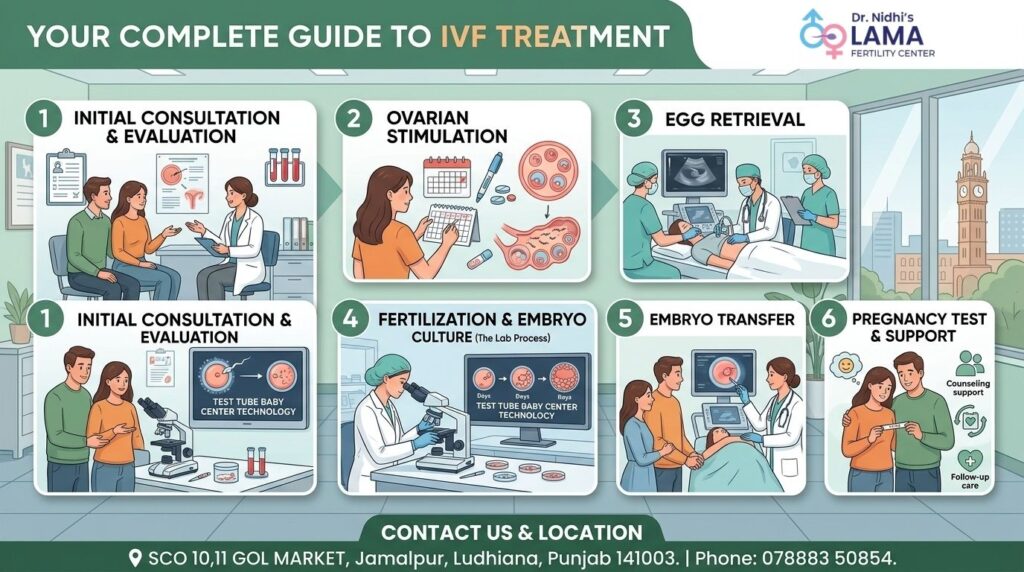
Step-by-Step IVF Procedure
Understanding the IVF Process step-by-step can help ease anxiety and set realistic expectations.
Step 1: Initial Consultation and Fertility Assessment
Your fertility specialist reviews medical history, conducts hormonal blood tests, ultrasound scans, and semen analysis to build a personalized treatment plan.
Step 2: Ovarian Stimulation
Hormonal injections are given for about 8–12 days to stimulate the ovaries to produce multiple mature eggs, rather than the single egg released in a natural cycle.
Step 3: Monitoring
Regular ultrasounds and blood tests track follicle growth, allowing the medical team to adjust medication dosage precisely.
Step 4: Egg Retrieval
Once follicles reach optimal size, a trigger injection is given, and eggs are retrieved under mild sedation using a fine needle guided by ultrasound — a quick, minimally invasive procedure.
Step 5: Sperm Collection and Fertilization
A sperm sample is collected the same day. Fertilization happens either through conventional insemination or ICSI (Intracytoplasmic Sperm Injection), where a single sperm is injected directly into an egg.
Step 6: Embryo Culture
Fertilized eggs are cultured in the laboratory for 3–5 days, developing into embryos or blastocysts under controlled conditions.
Step 7: Embryo Transfer
A healthy embryo is gently placed into the uterus using a thin catheter — a painless procedure that typically requires no anesthesia.
Step 8: Pregnancy Test
About 10–14 days after transfer, a blood test (beta-hCG) confirms whether implantation was successful.
IVF Success Rate
IVF Success Rate varies based on several factors, including maternal age, embryo quality, underlying fertility diagnosis, and clinic expertise.
General trends reported by international fertility bodies such as ASRM and ESHRE indicate:
| Age Group | Approximate Success Rate per Cycle |
|---|---|
| Under 35 | Higher success rates |
| 35–37 | Moderately good success rates |
| 38–40 | Declining success rates |
| Above 40 | Lower success rates, donor eggs may improve outcomes |
While exact percentages vary by clinic and case complexity, younger age and good embryo quality are consistently linked with better outcomes. At Lama Hospital & Fertility Clinic, treatment protocols are personalized to maximize each patient’s individual chances of success.
Benefits of IVF
- Effective solution for multiple types of infertility, including tubal and male factor infertility
- Allows genetic screening of embryos (PGT) to reduce risk of inherited disorders
- Option to use donor eggs, sperm, or a gestational surrogate when needed
- Enables family planning through embryo freezing for future pregnancies
- Higher control and monitoring compared to natural conception
- Suitable for same-sex couples and individuals pursuing single parenthood
Risks and Side Effects
While IVF is generally safe, it’s important to be aware of potential risks:
- Mild bloating, cramping, or bruising at injection sites
- Ovarian Hyperstimulation Syndrome (OHSS) — usually mild, rare in severe form
- Risk of multiple pregnancies if more than one embryo is transferred
- Emotional and physical stress during the treatment cycle
- Ectopic pregnancy risk (slightly elevated but still uncommon)
- Not every cycle results in pregnancy; multiple cycles may be needed
Your fertility specialist will discuss these risks in detail and monitor you closely throughout treatment to minimize complications.
Who is the Ideal Candidate?
IVF may be ideal for you if:
- You’ve tried conceiving naturally for over a year without success (or 6 months if over 35)
- You have diagnosed tubal blockage or severe male infertility
- Previous IUI cycles haven’t resulted in pregnancy
- You require genetic screening due to family history of inherited disorders
- You need donor eggs, sperm, or surrogacy support
- You want to preserve fertility through egg or embryo freezing
A thorough evaluation with a Fertility Specialist in Ludhiana will confirm if IVF is the most suitable path for your circumstances.
How to Prepare Before IVF
- Complete all recommended fertility investigations and blood work
- Maintain a healthy, balanced diet rich in folic acid, protein, and antioxidants
- Avoid smoking, alcohol, and excessive caffeine
- Manage weight to reach a healthy BMI range
- Take prescribed supplements such as folic acid and vitamin D
- Get adequate sleep and manage stress through relaxation techniques
- Discuss all current medications with your fertility specialist
- Attend all pre-treatment counselling sessions to understand the process fully
Lifestyle Tips During IVF
- Eat a fertility-friendly diet with whole grains, leafy greens, and lean protein
- Stay hydrated and maintain moderate, doctor-approved physical activity
- Avoid strenuous exercise and heavy lifting during stimulation and after transfer
- Practice stress-reduction techniques like meditation, yoga, or deep breathing
- Avoid alcohol, smoking, and recreational drugs completely
- Follow medication timings strictly as prescribed
- Keep follow-up appointments for monitoring and support
- Lean on your support system — partner, family, or counselling services
IVF Cost in Ludhiana
IVF Cost in Ludhiana depends on multiple factors rather than a fixed number, including:
- Type of IVF protocol used (standard IVF vs ICSI)
- Number of cycles required
- Medication dosage and hormonal response
- Need for additional procedures like PGT (genetic testing)
- Use of donor eggs, sperm, or surrogacy services
- Embryo freezing and storage requirements
- Diagnostic tests and pre-treatment investigations
Because every patient’s treatment plan is different, the most accurate cost estimate comes from a personalized consultation. Lama Hospital & Fertility Clinic offers transparent guidance on treatment planning so patients can make informed financial decisions without hidden surprises.
Why Choose Lama Hospital & Fertility Clinic?
Located in Jamalpur, Ludhiana, Punjab, Lama Hospital & Fertility Clinic is recognized as a trusted Test Tube Baby Centre in Ludhiana, combining advanced reproductive technology with compassionate, patient-centered care.
Here’s what sets us apart:
- Experienced fertility specialists with a patient-first approach
- Advanced IVF laboratory with modern embryology techniques
- Personalized treatment protocols tailored to individual diagnosis
- Transparent communication about costs and treatment plans
- Comprehensive support for male and female infertility
- Convenient location in Jamalpur, easily accessible across Ludhiana and Punjab
- Continued patient counselling and emotional support throughout the journey
If you’re searching for the Best IVF Clinic in Ludhiana, our team is committed to guiding you through every step of your fertility journey with care and clinical expertise.
IVF vs IUI: Which One is Right for You?
| Factor | IVF (In Vitro Fertilization) | IUI (Intrauterine Insemination) |
|---|---|---|
| Procedure | Fertilization happens outside the body in a lab | Sperm is placed directly into the uterus |
| Best for | Blocked tubes, severe male infertility, failed IUI, genetic screening needs | Mild male infertility, unexplained infertility, ovulation issues |
| Invasiveness | Moderately invasive (egg retrieval required) | Minimally invasive, simpler procedure |
| Success Rate | Generally higher per cycle | Lower than IVF, varies by cause |
| Treatment Duration | 4–6 weeks per cycle | Shorter cycle duration |
| Cost | Higher due to lab and procedural complexity | Comparatively more affordable |
Your fertility specialist can help determine whether IVF or IUI better suits your diagnosis and treatment goals.
Frequently Asked Questions
1. What is IVF treatment in simple words? IVF is a fertility treatment where eggs and sperm are combined in a lab to form an embryo, which is then placed into the uterus to achieve pregnancy.
2. How painful is the IVF process? Most steps involve mild discomfort. Egg retrieval is done under sedation, and embryo transfer is typically painless.
3. How many IVF cycles are usually needed? This varies by individual; some conceive in the first cycle, while others may need two or more cycles for a successful pregnancy.
4. What is the age limit for IVF treatment? While there’s no strict cutoff, success rates decline with age, particularly after 40. Your specialist will assess your ovarian reserve individually.
5. Is IVF treatment safe? Yes, IVF is considered safe and is performed globally for over four decades, though like any medical procedure, it carries some risks that your doctor will explain.
6. What is the difference between IVF and ICSI? ICSI is a specialized form of IVF where a single sperm is directly injected into an egg, often used for severe male infertility.
7. Can lifestyle changes improve IVF success? Yes, a healthy diet, avoiding smoking and alcohol, managing stress, and maintaining a healthy weight can positively influence outcomes.
8. How long does one IVF cycle take? A typical cycle takes about 4–6 weeks from ovarian stimulation to the pregnancy test.
9. Does IVF guarantee pregnancy? No treatment can guarantee 100% success. IVF significantly improves chances, but outcomes depend on individual factors.
10. What is the cost of IVF treatment in Ludhiana? Costs vary depending on protocol, medication needs, and additional procedures. A personalized consultation at Lama Hospital & Fertility Clinic provides an accurate estimate.
11. Can male infertility be treated with IVF? Yes, IVF combined with ICSI is highly effective for male factor infertility, including low sperm count and poor motility.
12. Is embryo freezing available for future use? Yes, embryo freezing allows patients to preserve embryos for future pregnancy attempts.
Medical Disclaimer
This article is for general informational and educational purposes only and does not constitute medical advice. Every patient’s fertility journey is unique. Please consult a qualified fertility specialist at Lama Hospital & Fertility Clinic or another licensed healthcare provider for diagnosis, treatment options, and personalized medical guidance before making any healthcare decisions.
Conclusion
IVF treatment has given hope to millions of couples worldwide struggling with infertility, and continued advancements in reproductive medicine keep improving outcomes every year. Whether you’re facing male infertility, female infertility, or unexplained fertility challenges, understanding the process, success factors, and preparation steps can help you approach treatment with confidence rather than fear.
If you’re exploring IVF Treatment in Ludhiana, choosing the right clinic and specialist matters. At Lama Hospital & Fertility Clinic in Jamalpur, Ludhiana, Punjab, our team is here to support you with expert care, transparent guidance, and compassionate treatment every step of the way.
Book Your Consultation Today
Your journey to parenthood starts with a single step. Contact Lama Hospital & Fertility Clinic, the Best IVF Clinic in Ludhiana, to schedule a consultation with our fertility specialists.
📍 Address: SCO 10, 11 GOL Market, Jamalpur, Ludhiana, Punjab 141003 📞 Phone: +91 78883 50854
Call now or visit us today to take the first step toward your dream of parenthood.